Representation bottleneck
Audio codecs and video latent grids produce sequences at different rates. A representation must support both semantic reasoning and faithful reconstruction.
Audio-video research survey
Foundations, Taxonomies, and Architectures
The Hong Kong University of Science and Technology
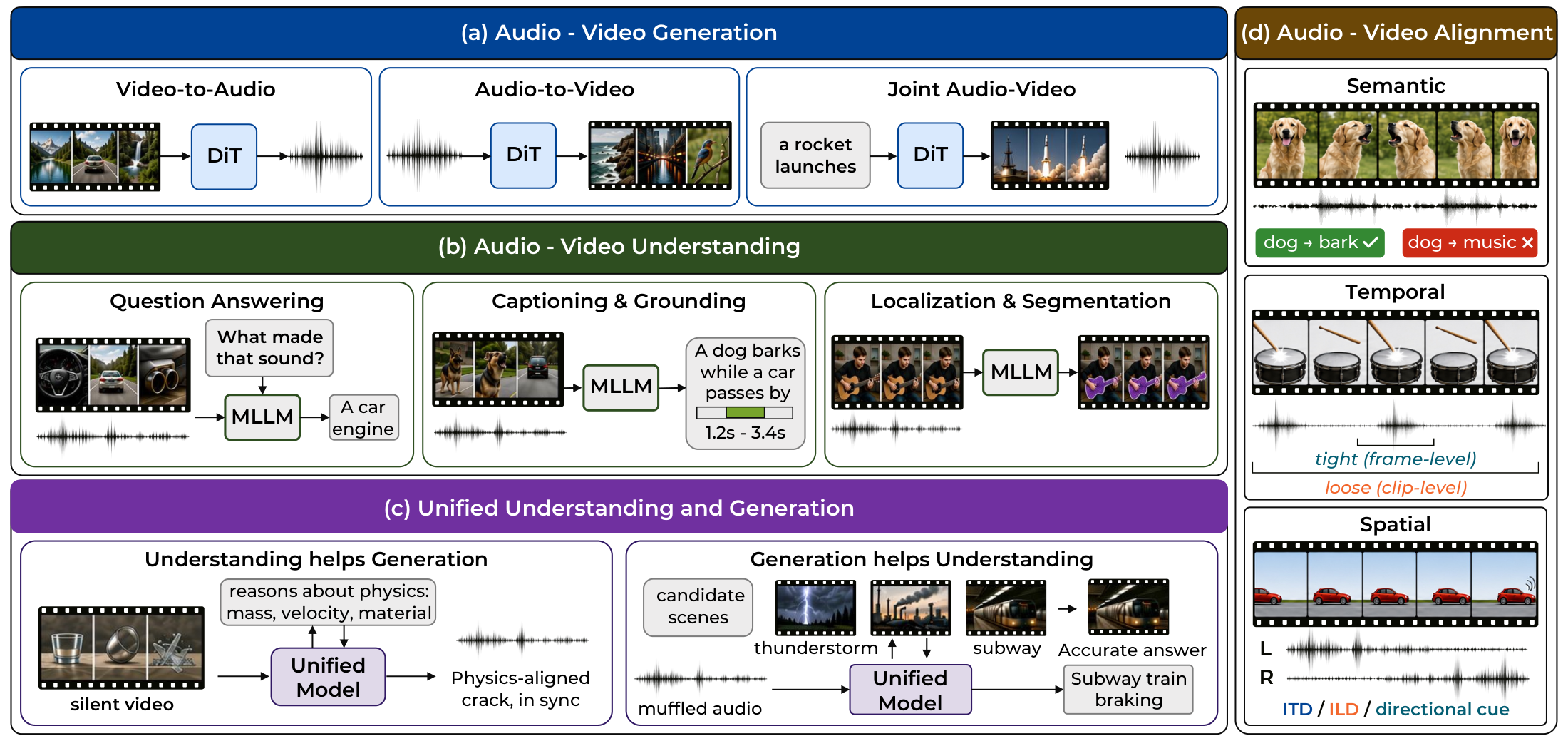
Audio–video alignment
Overview
How do models interpret sounding video, synthesize it, and bring both abilities into one system? The survey traces progress across generation, understanding, and unification, examining the tokenizers, datasets, and evaluation protocols behind them.
Audio-visual integration has become a central focus of multimodal learning, driven by demand for systems that can both comprehend and synthesize audio-video content. Much progress has been made independently in generation (video-to-audio, audio-to-video, and joint synthesis) and in understanding (audio-visual question answering, segmentation, and source localization), yet these trajectories remain largely isolated. Unified multimodal models, which combine autoregressive language modeling with diffusion-based generation, perform strongly in image-text domains but are underexplored for joint audio-video applications. This survey systematically reviews large audio-video multimodal models across three primary domains: (1) audio-video generation, covering cross-modal synthesis and joint generation with an emphasis on Diffusion Transformer (DiT) architectures and flow matching; (2) audio-video understanding, organizing task-specific models, self-supervised representation learners, and multimodal large language model (MLLM) generalists by how each acquires its task capability; and (3) unified understanding and generation models, assessing the four paradigms that integrate perception and synthesis within a single architecture, separating genuine audio-video systems from the image-text designs they borrow from, and consolidating what each paradigm requires into a blueprint for audio-video unification. We further analyze tokenization strategies, dataset curation, and evaluation protocols. We close with a pillar-by-pillar assessment of which capabilities are mature and which remain weak, together with four recurring open challenges: the representation bottleneck imposed by the audio-video token-rate asymmetry, long-horizon and real-time generation, grounding beyond correlation, and evaluation and data as shared infrastructure.
Taxonomy
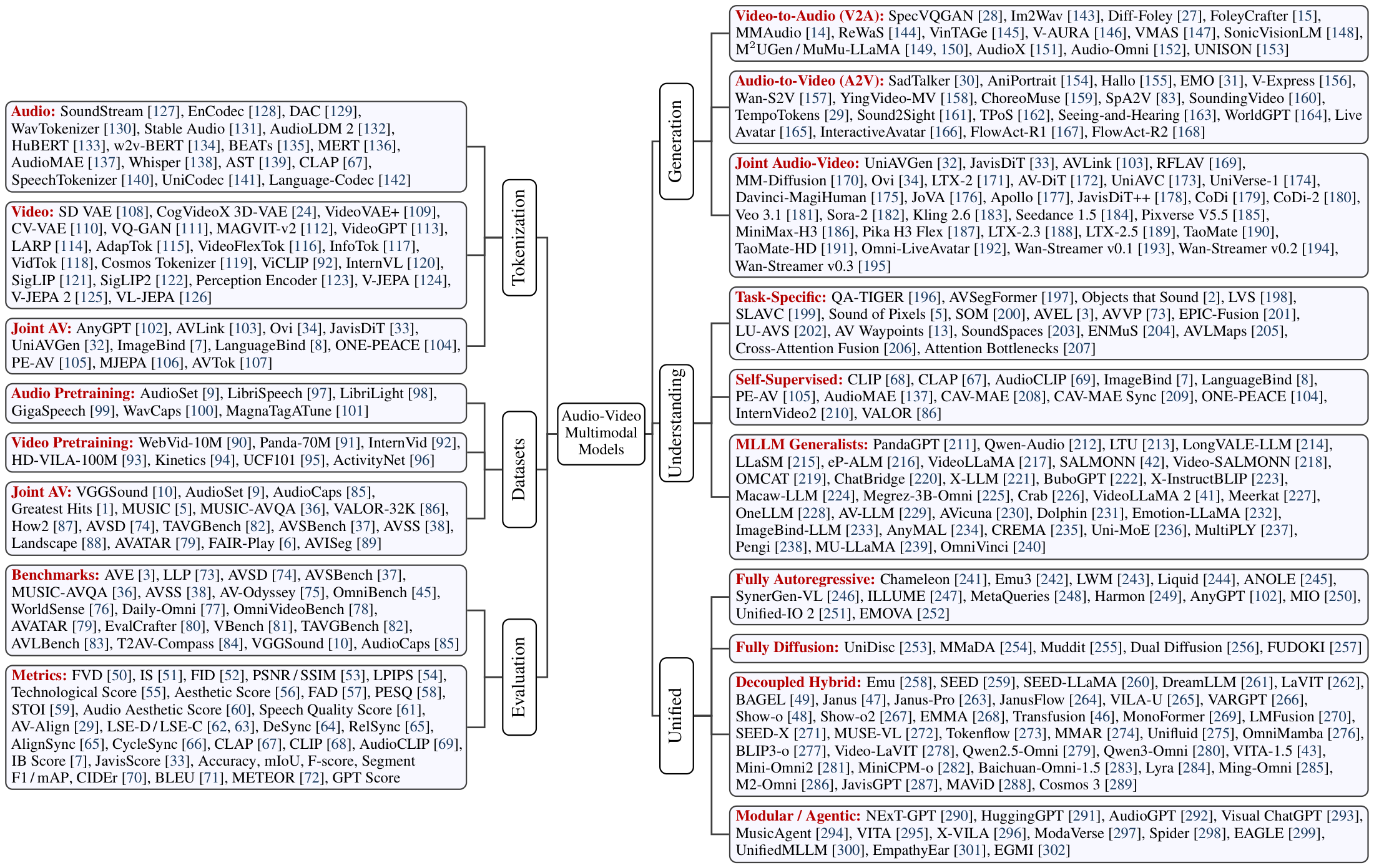
The taxonomy organizes research by synthesis direction, how models acquire understanding, and how architectures couple perception with synthesis.
Tokenization, datasets, and evaluation are shared across the three pillars.
Trends
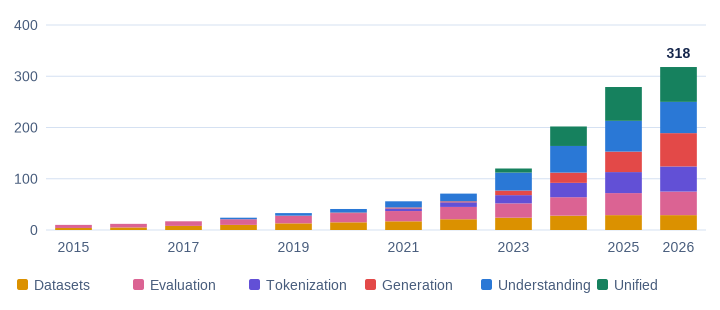
The survey chart plots 318 dated taxonomy entries across six branches; 78% appeared after 2022.
Open challenges
Audio codecs and video latent grids produce sequences at different rates. A representation must support both semantic reasoning and faithful reconstruction.
Streaming output increases the demand on memory, latency, and synchronization. Clip-level measures can miss drift over longer sequences.
Multiple sound sources, spatial localization, and counterfactual scenes require models to link events to the entities and actions that produce them.
Comparable splits, aligned training data, and joint metrics are needed to evaluate audio-video quality and synchronization together.
Reference library
Browse the survey’s references by year and topic.
Citation
@misc{pham2026unifiedav,
  title={Unifying Audio-Video Understanding and Generation: Foundations, Taxonomies, and Architectures},
  author={Pham, Kien T. and He, Zhenqi and Wang, Yanghao and Chen, Qifeng and Chen, Long},
  year={2026},
  note={Survey manuscript}
}